Toyota has finally done something that Land Cruiser fans have been asking for for years: it has made the legendary off-roader smaller.
The result is the 2026 Toyota Land Cruiser FJ, a compact 4×4 that has quickly picked up the unofficial “Mini Land Cruiser” nickname. It may be smaller than the Land Cruiser 250, but Toyota has been very careful not to turn it into a soft urban crossover.
The FJ has a proper ladder-frame chassis, part-time four-wheel drive, a naturally aspirated 2.7-litre petrol engine and a design that clearly takes inspiration from the tougher members of the Land Cruiser family. Toyota says the idea was to make the Land Cruiser easier to handle while retaining the reliability, durability and off-road ability associated with the name.
The car has already moved beyond the concept stage. Toyota officially launched the Land Cruiser FJ in Japan on 14 May 2026, with a starting price of ¥4,500,100 including Japanese consumption tax.
For British buyers, though, there is an important catch. Toyota has not announced an official UK price or UK launch for the FJ, so it would be wrong to treat it as a confirmed new model for British dealerships just yet.
What exactly is the Toyota Land Cruiser FJ?
The easiest way to understand the FJ is to think of it as the smaller member of the modern Land Cruiser family.
Toyota currently has several distinct Land Cruiser models, including the flagship 300 Series, the heavy-duty 70 Series and the 250 Series. The FJ joins that family as a more compact option designed to make the Land Cruiser experience accessible to a wider group of drivers.
And Toyota has not simply shrunk the 250.
The company has given the FJ its own character.
It has a shorter wheelbase, a smaller overall footprint and a more playful appearance, while still retaining the basic mechanical ingredients you would expect from a serious off-roader.
That combination could make it particularly appealing to people who like the idea of a Land Cruiser but find the larger models simply too big for everyday driving.
Mini Land Cruiser design
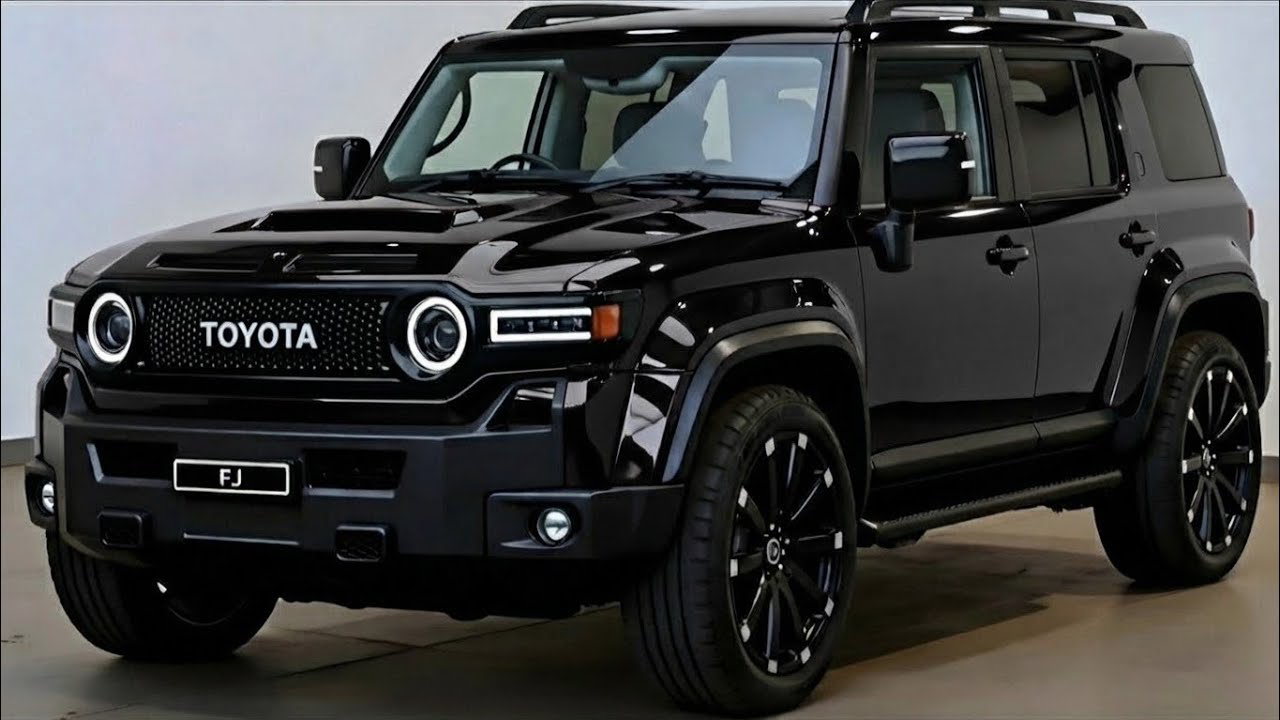
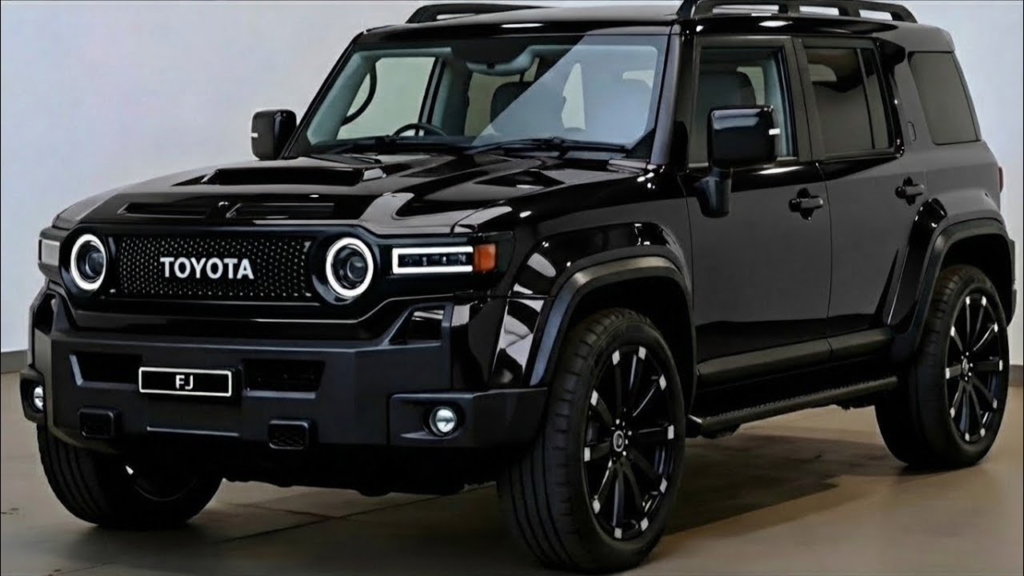
The first thing that stands out about the FJ is its shape.
It has a deliberately boxy cabin, upright proportions and chunky bodywork. The design does not try to hide the fact that this is an off-road vehicle.
Toyota has used a rectangular body shape with chamfered edges and what it calls a “dice” motif. The result is quite different from the increasingly rounded shape of most modern family SUVs.
The front end is particularly distinctive.
The headlights and rear lamps use a U-shaped design, while the bumpers and flared wheel arches give the FJ a wide, planted appearance.
There is also a rear-mounted spare wheel, which immediately tells you that Toyota has not designed this car simply as a fashionable city crossover.
It looks like something that is meant to be taken somewhere.
That is perhaps the most appealing part of the design.
Compact dimensions make a big difference
Despite carrying the Land Cruiser name, the FJ is relatively compact.
It measures 4,575mm in length, 1,855mm in width and 1,960mm in height, with a 2,580mm wheelbase.
Compared with the Land Cruiser 250, the FJ is 350mm shorter and 125mm narrower, while its wheelbase is 270mm shorter.
Those numbers might not sound dramatic until you consider where a vehicle like this is supposed to be driven.
A shorter wheelbase makes it easier to manoeuvre around tight trails, narrow tracks and awkward turns.
Toyota quotes a minimum turning radius of 5.5 metres, which should also make the FJ considerably easier to handle in normal urban environments.
That is one of the reasons the Mini Land Cruiser idea makes so much sense.
The larger Land Cruiser models are extremely capable, but their size can become a disadvantage when the road gets narrow.
The FJ aims to solve that problem.
2.7-litre petrol engine
Under the bonnet, the Japanese-market Land Cruiser FJ uses a 2.7-litre naturally aspirated four-cylinder petrol engine.
It produces 163 PS, equivalent to around 161bhp, and develops 246Nm of torque. Power is sent through a six-speed Super ECT automatic transmission.
There is nothing particularly exotic about those numbers.
In fact, compared with some modern turbocharged SUVs, the output may look fairly modest.
But that is not necessarily a disadvantage here.
The FJ has been designed around durability and predictable performance rather than chasing the biggest possible horsepower figure.
A naturally aspirated engine also has a relatively straightforward character, with power delivery that is easy to understand.
For an off-road vehicle that could potentially be used in remote locations, simplicity has its own value.
Four-wheel drive comes as standard
This is where the FJ separates itself from most compact SUVs.
Toyota gives the Japanese-market FJ part-time four-wheel drive as standard.
That means the vehicle has genuine off-road hardware rather than simply relying on electronic traction systems to imitate four-wheel drive.
Toyota has also fitted an electric rear differential lock, which can help when traction becomes difficult. There are also systems such as Hill Start Assist Control and Downhill Assist Control.
These are features that actually make sense on a vehicle intended for rough terrain.
The FJ is not just borrowing the Land Cruiser name for marketing purposes.
There is real hardware underneath it.
Off-road capability
The FJ’s compact dimensions are only part of the story.
Toyota says the vehicle has ground clearance and approach and departure angles equivalent to the Land Cruiser 250, while wheel articulation is comparable to the 70 Series.
That is a serious claim.
Wheel articulation is particularly important when travelling over uneven terrain. If one wheel lifts away from the ground too easily, traction can disappear very quickly.
The FJ’s suspension has been designed with this in mind.
At the front, it uses a high-mount double-wishbone arrangement, while the rear uses a four-link rigid axle with a lateral rod.
This is very different from the suspension setup you would normally find on a soft urban crossover.
It is another indication that Toyota has taken the off-road side of the FJ seriously.
A proper ladder-frame chassis
Perhaps the most important mechanical detail is the chassis.
The Land Cruiser FJ uses a ladder-frame structure, following the traditional Land Cruiser approach. Toyota says the platform has been adapted to fit the smaller dimensions of the FJ while improving rigidity around the frame.
This matters because body-on-frame construction is closely associated with vehicles designed to cope with serious loads and rough terrain.
It also helps explain why the FJ feels more like a genuine mini off-roader than a conventional compact SUV.
Toyota has used high-tensile-strength steel in the structure and additional underfloor spot welding to improve vibration damping and stability.
The goal is to keep the vehicle tough without making it unnecessarily uncomfortable on normal roads.
How practical is the Mini Land Cruiser?
The FJ may be compact from the outside, but Toyota has made a serious effort to use the available interior space efficiently.
It has a five-seat, two-row layout, with the rear seats split 60:40.
Those rear seats can slide forwards and backwards and recline, giving owners some flexibility between passenger space and luggage capacity.
Toyota quotes 795 litres of luggage space with the rear seats in use.
Fold the rear seats down and the available capacity rises to 1,607 litres.
That is an impressive amount of space for something that is supposed to be a compact Land Cruiser.
The square body shape helps here.
Instead of sacrificing interior room to a dramatically sloping roofline, Toyota has kept the cabin relatively upright.
That makes it easier to carry bulky items and should also give passengers a good sense of space.
Interior and technology
The cabin is more modern than the rugged exterior might suggest.
Toyota has designed the dashboard around clear visibility and straightforward controls.
The instrument panel is horizontally arranged, while the low-set cowl helps the driver see the road more easily. Toyota says the layout has been designed so that important functions can be recognised quickly while driving.
There is also a 12.3-inch display audio system with connected navigation support.
A Panoramic View Monitor and Blind Spot Monitor are included in the standard equipment listed by Toyota for the Japanese-market FJ.
That combination is particularly useful for an off-road vehicle.
When driving over rocks, steep sections or tight trails, knowing exactly where the corners of the vehicle are can make a big difference.
The technology is therefore not simply there to make the specification sheet look impressive.
Toyota Safety Sense
The FJ also comes with Toyota’s active safety technology.
The Japanese model includes Toyota Safety Sense, with features including the Pre-Collision Safety System and Lane Departure Alert.
This means Toyota has not treated the FJ as a purely mechanical off-road toy.
It is still designed to function as an everyday vehicle.
That is important because most owners will probably spend far more time driving to work, going shopping or travelling on normal roads than climbing difficult trails.
A good modern off-roader needs to be capable in both environments.
Fuel economy
The naturally aspirated 2.7-litre petrol engine is not particularly focused on fuel economy.
Toyota’s Japanese WLTC figure is 8.7km/l, which works out at roughly 24.6mpg UK.
That is considerably less impressive than what you might see from a modern hybrid SUV.
But this is where expectations need to be realistic.
The FJ has a ladder frame, four-wheel drive, a large petrol engine and genuine off-road hardware.
It is not trying to compete with a Toyota Yaris Cross on fuel consumption.
The trade-off is capability.
If you want a compact Toyota that prioritises fuel economy, there are plenty of other models in the range. If you want a small vehicle that can genuinely tackle difficult terrain, the FJ is playing a different game.
Customisation is a big part of the FJ
Toyota appears to understand that owners of off-road vehicles often like to personalise them.
The FJ has been designed with that in mind.
Toyota offers dealer-installed accessories and has also worked with ARB, a well-known off-road equipment manufacturer, to offer items such as roof racks, skid plates and rock rails in selected markets.
There are also MOLLE panels and exterior accessories designed to help owners carry outdoor equipment.
Even the bumpers have been designed with repairability in mind.
The front and rear corner bumpers are made in removable sections, meaning a damaged section can potentially be replaced without replacing the entire bumper.
That sounds like a small detail, but it is exactly the sort of thing that matters when a vehicle is actually used off-road.
2026 Toyota Mini Land Cruiser price
The official Japanese starting price for the Land Cruiser FJ VX is ¥4,500,100 including consumption tax.
The Japanese-market version has five seats, part-time four-wheel drive, the 2.7-litre petrol engine and six-speed automatic transmission.
However, this should not be converted directly into a UK price.
A British price would depend on taxes, homologation, import costs, specification and Toyota’s pricing strategy for the local market.
At the moment, Toyota has not announced a UK RRP for the Land Cruiser FJ.
So any website quoting a definitive UK price should be treated cautiously unless it is backed by an official Toyota announcement.
Will the Toyota Mini Land Cruiser come to the UK?
This is the question many British buyers are asking.
Unfortunately, there is no confirmed UK launch information at the moment.
Toyota officially launched the FJ in Japan in May 2026, but the company has not announced a UK-market price or sales date in the information currently available.
That is particularly frustrating because the FJ’s compact dimensions could actually suit British roads extremely well.
A full-size Land Cruiser can feel enormous on narrow country lanes and in older town centres.
The FJ is much easier to imagine using in those environments.
Its 5.5-metre turning radius and relatively narrow 1,855mm body could make it far more manageable.
Whether Toyota decides to bring it to Britain is another matter.
Could it compete with the Land Rover Defender?
If the FJ eventually reaches the UK, one obvious comparison will be with the Land Rover Defender family.
The two vehicles would not be identical.
The Defender is larger, more luxurious and available with a wider range of powertrains and body styles.
The FJ’s appeal would be different.
It would offer a more compact footprint, Toyota’s reputation for durability and a simpler, more rugged approach to off-road driving.
It could also appeal to people who like the Defender’s design but do not want something quite so large or expensive.
That is where the Mini Land Cruiser could find its niche.
Is the Land Cruiser FJ actually a Mini Land Cruiser?
Yes, but the nickname only tells half the story.
It is smaller than the 250, but Toyota has not simply scaled down the Land Cruiser formula.
The FJ has its own styling, shorter wheelbase and different packaging.
At the same time, the mechanical philosophy is unmistakably Land Cruiser.
There is a ladder frame, four-wheel drive, serious wheel articulation, a rear differential lock and off-road assistance systems.
That is much more than a marketing exercise.
The FJ genuinely appears to be designed to carry the Land Cruiser name.
Final verdict
The 2026 Toyota Mini Land Cruiser, officially called the Land Cruiser FJ, is easily one of the most interesting new Toyota SUVs of the year.
It takes the rugged character of the Land Cruiser family and puts it into a much smaller package.
The result is a 4,575mm-long, five-seat 4×4 with a ladder-frame chassis, 2.7-litre petrol engine, 163 PS, 246Nm of torque and a six-speed automatic transmission.
What makes it particularly appealing is that Toyota has not sacrificed the mechanical ingredients that make a Land Cruiser special.
It still has proper four-wheel drive, an electric rear differential lock, off-road driving assistance and suspension designed to cope with uneven terrain.
At the same time, it has enough interior space to be useful as an everyday family vehicle, with up to 1,607 litres of luggage capacity when the rear seats are folded.
The downside is fuel economy.
A quoted 8.7km/l WLTC figure means this is not going to be the Toyota you choose if your only priority is saving money at the fuel station.
But that is not really why the FJ exists.
It is about offering something smaller, more manoeuvrable and more approachable while retaining genuine Land Cruiser capability.
For Japanese buyers, the FJ is already a reality, with sales beginning on 14 May 2026.
For UK buyers, the story is still incomplete because Toyota has yet to confirm an official British launch and price.
If the Mini Land Cruiser eventually does arrive on British roads, though, it could be one of Toyota’s most interesting SUVs in years. It has the right combination of rugged looks, compact dimensions and genuine off-road hardware to stand out in a market increasingly filled with soft-roading crossovers.
And perhaps that is exactly why the Land Cruiser FJ has generated so much interest: it looks like a modern SUV, but underneath, it still has something properly old-school about it.